Saved copy of a news article by Carol Goodwin, Kitchener-Waterloo Record, December 5, 2003, kept for reference. Copyright remains with the publisher.
Tot recovering after stroke
Near-tragedy preventable with vaccination for chickenpox
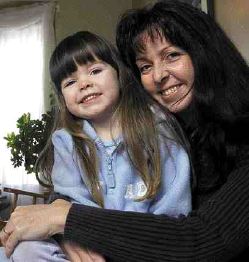 PETER LEE, RECORD STAFF
Brenda Lutz of Drayton is thankful daughter
Sydney, 4, is recovering from a
stroke.
DRAYTON (Dec 5, 2003)
In their worst nightmares, Brenda and Cory Lutz could not have anticipated the diagnosis. The pediatrician was talking about Sydney, their three-year-old daughter.
"She's had a stroke," the doctor told them.
Sydney, a bright-eyed charmer who just turned four, is making an amazing recovery from the massive -- and preventable -- stroke she suffered July 21, three months after getting chickenpox.
She will remain on blood-thinning Aspirin indefinitely and still gets therapy at home for speech and motor skills.
But the only outward sign of her ordeal is weakness in her left hand and arm, and an occasional confusion of words, her parents said this week at their home in Drayton.
A stroke can occur up to a year after a child gets chickenpox, said Dr. Ian Wilson, the Kitchener pediatrician who assessed Sydney when she was brought to Grand River Hospital.
"Sydney's not out of the woods yet," Wilson said.
Magnetic resonance imaging, or MRIs, will guide Sydney's treatment.
"The blood clot is still there, but surgery is not a good option," Wilson said.
And another stroke could kill her, Brenda and Cory were told at Toronto's Hospital for Sick Children, where Sydney stayed for 15 days.
"Every day we think about it, worry about it," Brenda said with tears in her eyes as she watched her older daughter, Kirsten, 5, play with Sydney.
"All the time," her husband agreed. "The devastation is horrific."
The girls had the chickenpox within a week of each other.
The couple learned, too late, that Sydney's life-threatening stroke was preventable by a vaccine approved and made available in Canada in 1998.
The varicella vaccine got a strong recommendation a year ago from the Commission on the Future of Health Care in Canada, led by former Saskatchewan premier Roy Romanow.
Some provinces and territories pay for the vaccine, and it's also recommended by the National Advisory Committee on Immunization. But the varicella vaccine is not mandated or paid for by Ontario's health system.
"It's a no-brainer," said Wilson.
Wilson, who is an assistant clinical professor of pediatrics at McMaster University in Hamilton and a member of the Canadian Pediatric Society, is pushing the province to start paying for the varicella vaccine and for two other approved vaccines which protect children against meningitis and pneumococcal infections.
"It blows me away that not even family doctors are mentioning (the vaccine)," Cory said as he and Brenda quietly recalled the worst time of their lives.
On July 21, the Lutzes were about to leave on a camping trip. The night before, Sydney complained of a headache and threw up. Assuming she was coming down with something, Brenda gave her Tylenol and put her to bed. Early the next morning, the couple heard the child whimpering.
When Brenda lifted Sydney to take her to the bathroom she realized something was terribly wrong.
"She had no control of her left leg or her left side," Brenda said. "She was a dead weight, like a rubber doll. Then she spoke and the left side of her mouth drooped."
"My first thought was, 'She's had a stroke,' which I immediately rejected. I didn't even say it out loud. 'No way,' I thought. 'She's three years old.' "
The couple called 911 and an ambulance arrived within minutes, taking them to a hospital in nearby Palmerston. The doctor there suspected a seizure and wanted to keep Sydney for observation.
But her parents instinctively knew better and insisted an ambulance take Sydney to Grand River Hospital, where Wilson, the on-call pediatrician, was waiting.
The first question Wilson asked was, "Has she had the chickenpox?"
After a CT (computerized tomography) scan, an hour-long MRI and blood tests, Wilson asked Brenda and Cory to accompany him to a private room.
"As soon as he said, 'I'd like to talk to you,' all we felt was fear," Brenda said. "I don't know how we walked down the hall to that room."
Then they heard the pediatrician's words: "She's had a stroke."
Not a minor stroke, but a massive arterial ischemic stroke, caused by a clot in an artery supplying blood to the brain.
The MRI picture showed the damage. Brenda and Cory saw that more than a third of the right side of Sydney's brain, which controls the left side of the body, had been affected.
"Reality smacked me in the face," Brenda said. "But I was in denial for two days."
Wilson arranged for Sydney to be transferred to the Hospital for Sick Children, where she remained in intensive care for two days and then another two weeks getting treatment.
Cory and Brenda began writing down their questions, never letting their girl out of sight, while trying to make child-care arrangements for Kirsten, who was bewildered and miserable at the sudden absence of her sister.
Their first questions were: "Why? What caused this?"
The answers only added to the couple's anguish.
The chickenpox virus remains for up to a year in the nerve cells at the base of the brain and can cause irregularities in blood vessels, Wilson and other specialists told the Lutzes.
One possible complication from the latent chickenpox virus is stroke. The odds are low -- about one in 15,000 to one in 22,000, said Dr. Gabrielle deVeber, a neurologist on the Sick Kids' stroke team and the author of a 1999 study on chickenpox and stroke.
Because of these odds, deVeber and her colleagues have not recommended universal access to the vaccine.
Wilson passionately disagrees.
"Dr. deVeber is narrowly focusing on stroke," Wilson said. "There are other serious complications from chickenpox that cause up to 500 Canadian children a year to be hospitalized."
About one in 100,000 children die from complications arising out of chickenpox, said Dr. Liana Nolan, Waterloo Region's medical officer of health. Last month, at Nolan's urging, regional council asked the province to start paying for the vaccines for all children, and not just for a small group of high-risk youngsters.
The possible complications from chickenpox include meningitis, flesh-eating disease, encephalitis (swelling of the brain), seizures, cerebella ataxia, which causes unsteadiness on the feet, and a cellular skin infection.
"The vaccine is funded in Prince Edward Island, Alberta, NorthWest Territory and Nunavut," Wilson said. "A good case can be made for immunization."
The vaccine costs more than $200 per child. But Wilson said the societal cost of chickenpox is extensive. The initial outlay by the province would be recovered in two years.
Health Ministry spokesman John Letherby said the province is looking at the issue. "It has been mentioned by the new government, which is looking at a variety of public health initiatives."
Wilson agreed that not enough family physicians fully inform parents of chickenpox risks and the vaccine.
Just this summer, the Canadian Medical Protection Association, the national legal defence fund for doctors, warned family doctors to talk to parents about the vaccine or risk malpractice suits, he said.
Sydney is a fighter, impressing her doctors at Sick Kids, as well as her therapists, with her resilience and progress.
The ordeal has made the Lutzes stronger, as a couple and as parents, they said. Each new day is a gift.
"Last Sunday was her birthday," Brenda said. "We looked at her and said, 'She's here, let's celebrate.' She wanted to go bowling, so we did."
Related reading