Deaths attributed to neck manipulation by inquest or coroner
The treatments were frequently for something else entirely. Mathiason had tailbone pain, and her upper neck was manipulated more than forty times. Lewis had headaches, not neck pain. Under the subluxation model taught in chiropractic colleges the upper cervical joints are treated as the master control point for the whole body, so the neck is adjusted regardless of the presenting complaint.
Laurie Jean Mathiason
Age 20. Treated for tailbone pain; her upper neck was manipulated more than forty times. She suffered a fatal vertebral artery dissection. A Saskatchewan inquest attributed her death to the manipulation. Her mother, Sharon Mathiason, has campaigned on this ever since.
Lana Dale Lewis
Age 36. Presented with headaches, not neck pain. The coroner's office initially declined an inquest, then reversed. After a long and heavily lawyered proceeding, the jury found the death was caused by chiropractic neck manipulation. Her sister Judy Anne Ford has spoken publicly since.
Pierrette Parisien
Age 45. A Quebec coroner attributed her death to chiropractic upper-neck manipulation and called for a practice standard — the third Canadian official finding to reach the same conclusion in under a decade.
Dora Labonte
Age 40. Died after a sudden stroke, days before her 41st birthday. On the evening of 17 June 2002 she phoned her husband Joe, away on business, to say the chiropractor had done something that frightened her. No inquest was held.
Sandra Nette
Left almost totally paralyzed after an Edmonton chiropractor manipulated her upper neck. Both vertebral arteries were torn on the inside. She and her husband David brought the largest chiropractic action ever filed in Canada.
Diane Rodrigue
Age 30 when she had a massive stroke in the chiropractor's office and was left completely paralyzed. The chiropractor never accepted blame but settled for a million dollars. She depends on machines to breathe and on caregivers to feed and bathe her, and for years could not speak.
Kim McCormick
Age 32, a mother of three, died suddenly after a spinal manipulation. Her husband Michael went public in November 2009 and testified at the Connecticut informed-consent hearings two months later.
Les Limage
A Waterloo man who attributed his stroke to a chiropractic neck adjustment — one of the local cases that brought this issue into Dr. Polevoy's own region.
How a neck adjustment causes a stroke
The two vertebral arteries run up through bony canals in the cervical vertebrae before joining to supply the brain stem. A high-velocity rotational thrust applied to the upper neck can tear the inner lining of one of these arteries — a vertebral artery dissection. Blood enters the tear, a clot forms, and the clot travels into the brain stem or cerebellum. The same can happen to the carotid arteries.
The result ranges from transient symptoms to locked-in syndrome to death. Onset is often delayed by hours or days, which is one reason the connection is so easily missed and so easily denied. Patients present to emergency departments with headache, neck pain, dizziness, double vision or slurred speech, and are rarely asked whether anyone has recently manipulated their neck.
Cervical artery dissection is a leading cause of stroke in adults under 45. It accounts for a disproportionate share of strokes in young and middle-aged patients — a group otherwise at low risk, and the group that makes up the majority of chiropractic neck-manipulation patients.
Women appear to be at increased risk. Of the deaths documented above, the victims were 20, 36, 40 and 45 years old. Diane Rodrigue was 30 when she was paralyzed. Kim McCormick was 32.
Anatomy references held on this site


The Laurie Jean & Lana Dale Memorial Moratorium
The families of five victims and their supporters held press conferences across Canada demanding an immediate halt to all chiropractic upper-neck manipulation. Two inquests had by then found chiropractors at fault. Numerous lawsuits had been filed. Provincial governments were still paying for the procedure.
The families were backed by paediatricians, neurologists and other specialists who had watched chiropractic regulators avoid the question for years. The chiropractic associations issued a press release the day before.
- The Memorial Moratorium — full documentDOC · 50 pp
- Moratorium press release, TorontoRTF 30 April 2004
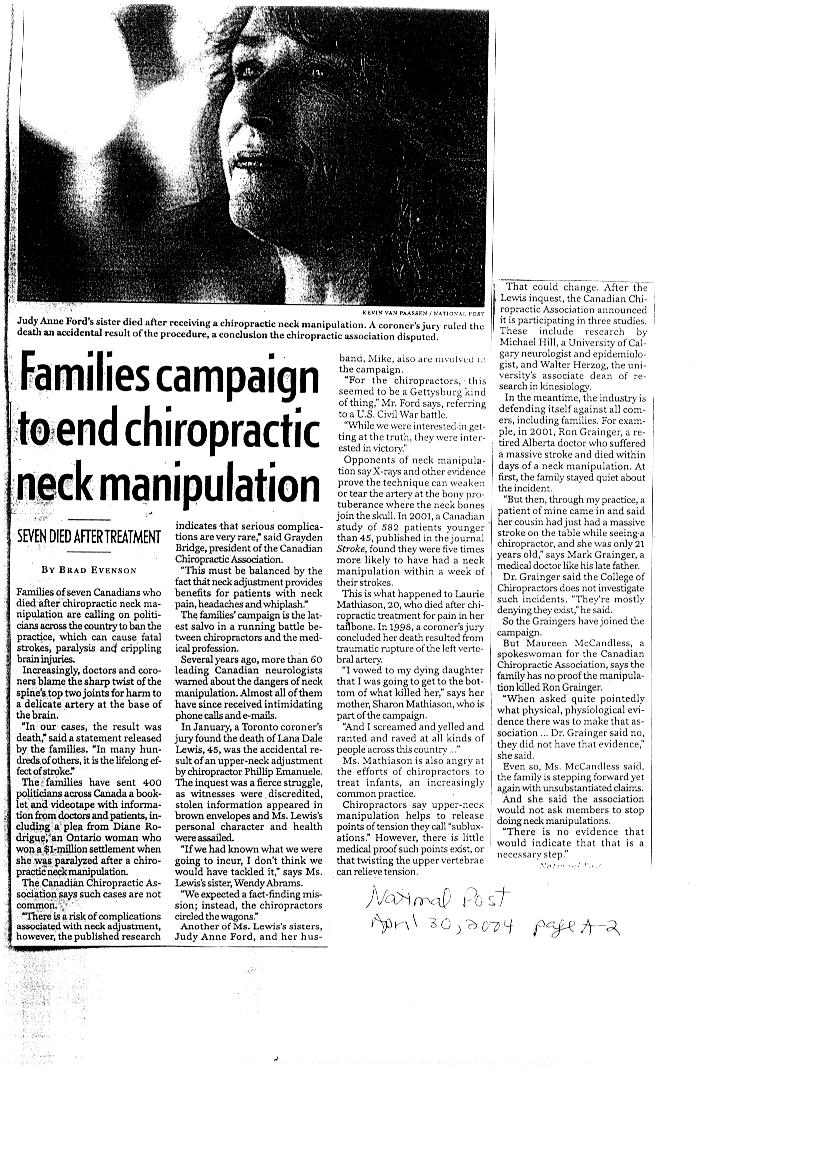
- Families campaign to end chiropractic neck manipulation National Post, p. A2 · 30 April 2004 · page image
- A call to ban neck manipulations Edmonton Sun · 1 May 2004
- Grieving mother urges government to halt neck manipulations Saskatoon StarPhoenix · 3 May 2004
- Science or quackery? Danielle Smith, Associate Editor · Calgary Herald · 22 May 2004 — a hard look at the industry's failure to act, including a critique of Dr. Walter Herzog's University of Calgary research · letters in response
"Chiropractors must follow the scientific standard"
Dr. J. William Kinsinger, Dr. Marvin Levant, Judy Ford and Sharon Mathiason set out the argument in the National Post. Their case was that the deaths were not a therapy gone wrong but the predictable outcome of a philosophical belief that upper-neck manipulation is a cure-all.
Laurie died because of a false, non-scientific philosophical belief that chiropractic highest-neck manipulation is a cure-all.
Sharon Mathiason, quoted in the op-ed
They pointed out that the link has been described in the medical literature for sixty years — in the Journal of Forensic Sciences, the Journal of Clinical Pathology, JAMA, CMAJ and the BMJ — while every provincial and state licensing body continued to deny it. The British Columbia College of Chiropractors told the public in 2006 that much of the available information was based on faulty or biased research.
The standard they proposed
Deliberately narrow, and its authors argued it could not be rationally opposed:
- No upper-neck manipulation on infants and children.
- No upper-neck manipulation on patients who have no neck pain.
- No upper-neck manipulation as part of a philosophy claiming to prevent or treat organic illness.
They argued it should be imposed from outside, the way the FDA and Health Canada impose drug standards on physicians: the three provinces then funding chiropractic should stop payment until the standard was met, insurers and workers' compensation boards should do the same, and colleges teaching the philosophy should stop.
Authors: Dr. J. William Kinsinger, an American physician with a special interest in alternative medicine; Dr. Marvin Levant, a retired Alberta radiologist; Sharon Mathiason, mother of Laurie Jean Mathiason; and Judy Ford, sister of Lana Dale Lewis. National Post, Friday 18 May 2007, p. A17.
Lawsuits and rulings
Gallant v. chiropractor — Newfoundland, 2010
The most useful Canadian ruling on this page, because it turns on informed consent rather than on the causation fight. Abraham Gallant suffered permanent hearing loss and impaired balance on his right side following a cervical manipulation. He argued he was never properly informed of the risks and would not have consented had he been. The defendant argued the symptoms were viral rather than vascular, and that consent had been fully informed.
The court found against the chiropractor on all three questions: that she breached her duty of disclosure; that a properly informed plaintiff would not have consented; and that the cervical manipulation caused his injuries. Liability in negligence followed, with damages to be assessed.
- Gallant ruling — full decisionPDF Newfoundland · original action filed 2009
Nette v. Stiles — Alberta, 2008
Sandra Nette and her husband David sued the chiropractor, the Alberta College and Association of Chiropractors and the provincial government for half a billion dollars — framed as a class proceeding covering anyone in Alberta treated with inappropriate and non-beneficial adjustments.
A perfectly healthy young woman's life has been irreparably and devastatingly damaged as a result of her exposure to a chiropractor's manipulation of the vertebrae in her upper neck to correct alleged subluxations.
From the statement of claim
- Complete statement of claimPDF · 81 pp
- Anecdotes are not enough to condemn chiropractorsPDF Susan Martinuk · Calgary Herald · 18 July 2008 — attacking Dr. Kinsinger
- Neck911's response to the Martinuk columnPDF Includes Dr. Wallace Sampson and Dr. Kinsinger in the Scientific Review of Alternative Medicine
- Patient advises saying no to neck manipulationPDF Diane Dingley and Dr. Kinsinger, letter · Calgary Herald · 22 July 2008
Les Limage — Waterloo, Ontario
- Stroke victim blames chiropractic neck adjustment for his condition Lianne Elliott · The Record · 27 April 2002
The Connecticut informed-consent hearings
A debate that had run for years inside chiropractic associations went public when stroke victims pushed Connecticut regulators to require that chiropractors warn patients of the risk before manipulating their necks. The Board of Chiropractic Examiners heard evidence over three weeks.
| Session | Who testified |
|---|---|
| 5 Jan, a.m. | After argument on motions to recuse a board member and exclude evidence, testimony opened with William Lauretti, DC, for the Connecticut Chiropractic Association. |
| 5 Jan, p.m. | Cross-examination of Lauretti continued, followed by James Lehman, DC and Clay McDonald, DC. |
| 6 Jan, a.m. | After argument on a motion to exclude testimony about subluxation, intervenor Jann Bellamy of the Campaign for Science-Based Health Care testified for the rest of the session. |
| 6 Jan, p.m. | Gerald Clum, DC for the association; then intervenor Sharon Mathiason on the death of her 20-year-old daughter; then Gina Carucci, DC, association president. |
| 19 Jan, a.m. | Dr. Douglas Fellows for the Connecticut Medical Examining Board on informed consent, and George Curry, DC of the Connecticut Chiropractic Council — a subluxation believer who could not answer a straightforward question from Norman Pattis, counsel to the Chiropractic Stroke Awareness Group, about whether he actually touches a patient to perform a cervical manipulation. |
| 19 Jan, p.m. | State Senator Len Fasano, and stroke victims Janet Levy, Britt Harwe and Christa Heck. Susan Hoffman and Michael McCormick testified about the deaths of their spouses. |
| 22 Jan, a.m. | Professor David Cassidy of Toronto argued once more that there is an association but no excess risk, and that case reports are unreliable. |
| 22 Jan, p.m. | Dr. Murray Katz of Montreal was questioned for more than three hours by the board and its counsel, who raised the same discredited material about him that chiropractors have used for years whenever he testifies. |
The Chiropractic Stroke Awareness Group
CSAG was formed to raise public awareness of the risk of stroke and death from chiropractic cervical adjustment, to find others who had been injured, and to prevent further needless suffering. It represents hundreds of people across the United States.
In 2007 the group expanded a television public-awareness campaign onto Connecticut's ABC and Fox affiliates, asking viewers directly whether they had been injured by a chiropractor and providing contact details for support. The response, according to spokesperson Amanda Thompson, was overwhelming.
The chiropractic industry remains more concerned about protecting profits than protecting their patients.
Amanda Thompson, CSAG · October 2007
CSAG has also documented harassment of its members by chiropractors.
What the peer-reviewed literature says
Canadian Stroke Consortium — CMAJ, 2000
John W. Norris, Vadim Beletsky and Zurab G. Nadareishvili reported for the Consortium that although the first carotid dissection from chiropractic manipulation had been described more than fifty years earlier, the frequency of carotid and vertebral dissection as a cause of stroke had only been recognised in the preceding decade. In a Canadian survey, cervical artery dissection was among the most common causes of stroke in patients under 45.
Their conclusion was unambiguous: most patients undergoing therapeutic neck manipulation will have no ill effects, but there is no doubt that chiropractic neck manipulation can dissect the carotid or vertebral arteries and cause a stroke. Until a high-risk group can be identified, they wrote, chiropractors should inform every patient of possible serious complications beforehand. They also urged physicians to ask every suspected ischaemic stroke patient on admission about recent head or neck injury or manipulation.
UCSF retrospective study — Neurology, 2003
Neurologists at the University of California, San Francisco reviewed stroke cases at two major academic medical centres and concluded that chiropractic manipulation of the neck can cause vertebral artery dissection leading to stroke or transient ischaemic attack.
Cervical artery dissection — Canadian Journal of Neurological Sciences, 2000
A series of 26 consecutive patients with vertebral artery dissection. One in ten was related to chiropractic neck manipulation. The authors' central finding was diagnostic: in younger patients with typical symptoms, dissection is frequently not considered at all, and the diagnosis is often missed until the stroke has already developed.
Neuro-ophthalmologic complications — 2000
M.W. Devereaux, Department of Neurology, University Hospitals of Cleveland / Case Western Reserve, described cervical manipulation as an important cause of vertebrobasilar and occasionally carotid distribution strokes, with neuro-ophthalmologic findings a common and sometimes isolated feature. Reports a case of chiropractic-induced occipital lobe infarction with homonymous hemianopsia.
Edzard Ernst — JRSM 2007 and Perfusion 2010
In the Journal of the Royal Society of Medicine in July 2007, Professor Ernst wrote that spinal manipulation is associated with frequent, mild and transient adverse effects as well as with serious complications that can lead to permanent disability or death. The paper carried 75 academic references. He had by then collected details of around 700 cases, and was careful to say he was not calling for a ban — only for the practice to be regulated far more carefully.
His 2010 review in Perfusion went further. Reviewing a case-control study that had cast doubt on causation, he found several weaknesses in it and concluded that the balance of probabilities indicates the association is in fact causal.
- Vascular accidents after chiropractic spinal manipulation: myth or reality?PDF E. Ernst · Perfusion 2010; 23:73–74
- Risk of chiropractic neck manipulation Medical Journal of Australia
- When simple actions ravage arteries Jane Brody · New York Times · 3 April 2001
- Call for a chiropractic stroke investigation in the UK All cases occurred within 24 hours of manipulation
- Study assesses limitations of chiropractic care Marlene Habib · Canadian Press — 29% of low-back patients treated inappropriately, care uncertain in a further 25%
An observation from practice. Over twelve years of running an ambulatory care and acne clinic in Waterloo — not a neurology or neurosurgery practice — three of Dr. Polevoy's own primary care patients had strokes following chiropractic treatment. That is roughly one in five thousand patients in a single office, against the one in a million or one in five million routinely cited by chiropractic leadership as proof the procedure is safe.
How the profession and its regulators responded
The pattern is consistent across three countries: deny causation, attack the messenger, and characterise the coverage as a scare story.
United Kingdom
Barry Lewis, then president of the British Chiropractic Association, accused Professor Ernst of distortion, errors and misinterpreting data, and of inflating his evidence out of all proportion. Peter Dixon, chairman of the General Chiropractic Council, dismissed the 2007 JRSM paper as another research scare story that served neither the public nor researchers.
In December 2006 Dixon had gone further in the Daily Mail, asserting that there is no available evidence that neck manipulation by chiropractors has ever caused a stroke, that Ernst likes to speculate and then claim he must be right because nobody has disproved him, and that serious side effects are so rare that meaningful statistics are hard to gather — every human activity carries some risk, he wrote, including a walk in the park.
A GCC spokeswoman noted that of 2,300 registered chiropractors, only one had been disciplined for breaching guidelines since 2001. Searching Google Scholar for Dixon's own published work on chiropractic returns nothing of substance. The UK's Stroke Association had, at the time, said nothing whatsoever about chiropractic. The GCC's website.
Canada
The Canadian Chiropractic Association issued a press release the day before the 2004 Memorial Moratorium press conferences. Its website carried a safety statement but no searchable mention of stroke, and nothing on pediatric chiropractic. When more than sixty Canadian neurologists signed a letter warning that neck manipulation can cause strokes, the chiropractors responded with written threats and the government did nothing.
World Chiropractic Alliance
The WCA asked ChiroWatch to post its position paper on stroke risk. In fairness to the profession it has been linked here since, and readers are invited to send their own questions about its claims.
Frances Denoon — a case the courts cleared
Frances Denoon was in her twenties when she pulled a nerve in her neck exercising. She saw a registered chiropractor and felt a crack during treatment. She could not focus and realised she was not forming words clearly. She suffered a brain-stem stroke and now has poor balance and cannot write with her right hand. A court cleared her chiropractor of negligence.
How the story was covered
CTV W-FIVE, Harm or Heal? — 26 April 2002
The programme that brought Diane Rodrigue's case to a national audience.
The CTV copyright dispute — an editorial by Dr. Terry Polevoy
When the five families of stroke victims produced their own 52-minute video, a small portion included news footage by CTV's Lloyd Robertson and Avis Favaro. CTV's lawyers demanded every copy be returned or destroyed on copyright grounds, arguing the segments had been taken out of context and selectively used to support a particular position — a moratorium on chiropractic neck manipulation — whether characterised as educational, political or legal.
W-FIVE's own Harm or Heal? remained available in full on CTV's website. The question the demand raised was why tapes distributed to media and to hundreds of Canadians had to be recalled, and why the families' use of them was political rather than educational.
This is not a political movement. It is a movement to defend families from the leaders of an industry who treat an unscientific philosophy as though it were carved in stone, and who have taken responsibility for none of it.
If the chiefs of paediatrics of every teaching hospital in Canada appealed to government about the dangers of pediatric chiropractic and were ignored, and if scores of Canadian neurologists demanded an end to highest-neck manipulation and were threatened in writing for it while government did nothing — what recourse is left to these families?
RTÉ Prime Time, Ireland — 5 May 2005
Investigative anchor Donagh Diamond examined the dangers of chiropractic therapy. After covering several deaths linked to homeopaths in Ireland, RTÉ producers travelled to Canada for the Mathiason, Lewis and Rodrigue stories. The interviews with Dr. Brad Stewart, a neurologist at the University of Alberta, are the strongest part of the programme.
Self Magazine — May 2007
"A deadly twist" opened with Christa Heck crumpled across the front seat of her SUV, unable to right herself, ten minutes after a routine follow-up at her chiropractor's office. She later testified at the Connecticut hearings.
Spin Doctors — CANOE.CA
Paul Benedetti and Wayne MacPhail's two-part investigation. Spin Doctors I covered the risks of neck manipulation and the inadequate protection of the public. Spin Doctors II covered chiropractors presenting themselves as paediatricians. Their June 2000 follow-up reported that misleading statements by chiropractors in several newspapers may have been why the Coroner's Office reversed itself and called the Lana Dale Lewis inquest, and that three leading Canadian chiropractors had withheld information about a 1996 chiropractic death. Their book, Spin Doctors: The Chiropractic Industry Under Examination, followed.
CBC
More than sixty neurologists signed a letter warning that chiropractic neck treatment can lead to stroke: improper rotation tears a blood vessel and a clot forms. CBC Winnipeg's Nancy Gregory reported on why chiropractors insist there is little or no risk, with Dr. James Norris on the Stroke Consortium's preliminary finding that strokes after cervical manipulation are likely underestimated.
Source documents held on this site
| Document | Source and date |
|---|---|
| Nette v. Stiles statement of claimPDF | Alberta · 12 June 2008 · 81 pp |
| Gallant rulingPDF | Newfoundland · January 2010 |
| Ernst, vascular accidents reviewPDF | Perfusion 2010; 23:73–74 |
| Memorial MoratoriumDOC | 30 April 2004 · 50 pp |
| Moratorium press releaseRTF | Toronto · 30 April 2004 |
| CCO newsletter transcript | College of Chiropractors of Ontario |
| Lana Dale Lewis inquest file | Ontario · 1996–2004 |
| "Dr. Neck" cartoon | Calgary Herald · 22 May 2004 |

Before anyone manipulates your neck
- Ask what is being treated. If your complaint is not neck pain, ask why your upper neck is being adjusted at all.
- Ask for the risk disclosure in writing. Canadian and international neurologists have called for informed consent before every cervical manipulation. Gallant turned on exactly this point.
- Decline upper-neck manipulation for a child. There is no evidence base for it, and the proposed scientific standard excludes it outright.
- Know the warning signs. Sudden severe headache or neck pain, dizziness, double vision, slurred speech, facial droop or weakness after a manipulation is a medical emergency. Go to hospital and tell them your neck was manipulated.
- Report it. Every province has a complaints route, and the regulators only act on what reaches them.
File a complaint — provincial directory Browse the Bad Chiro Files